One of the more discussed issues in cricket is "walking". In short, if you are out, but the umpire gives you 'not out', do you leave voluntarily?
Aussie captain Ricky Ponting is one player who appears to be firmly in the 'no' camp. Today, in the first match of the new year, Ponting (on 17) appeared to edge one to the wicketkeeper. Ponting stayed, and the umpire ruled that he didn't hit it.
Then on 55, Ponting inside-edged the ball onto his leg. Ironically, the same umpire again judged that Ponting didn't hit it, and hence gave him out lbw.
And this is the basis of 'non-walker' theory - that when an umpire error goes against you, you have to leave. Therefore (they say) when a decision favours you, you should get to stay.
But the thing that really tips it (for me) is the carry-on of players when they do get given out. There'll be a short stare at the umpire (long enough to make a point - short enough not to be fined for bad sportmanship) a glance towards the bat (in the case of inside edge) all followed up with some grumpy stomping off the field (like a child being sent to their room).
Of course, they'll say that it's all just a natural reaction, and impossible to supress. Yet when they "get away with one", the emotion of guilt seems much easier to hide.
In my view, if batsmen are going to claim "the umpire's the one who decides if i'm out", then it has to be true when it doesn't suit - not just when it does.

Wednesday, January 02, 2008


Saturday, April 28, 2007
True Supporters
Up until now, i have resisted writing too much about the Cricket World Cup. Partially because of the controversies, and partially because i've just been caught up in Australia's sensational performance. But the other day something caught my eye (or rather my ear) and i just had to comment.
 In England's last chance to make the semi-finals, the match with South Africa, they put up a performance which could best be described as woeful. After being bundled out for a mere 154 (from 48 overs, with a tops score of 46 by Strauss) the English bowlers conceded the same amount of runs in less than 20 overs, taking just the one wicket. Clearly this was the end of England's chances in the World Cup, which left their fans disappointed (although you'd think they'd be used to it - after all, they follow England;)
 English supporters, being who they are, decided to express their emotions by booing the captain at the on-field post-match presentation/interview. I've never understood the concept of booing one's own team. By definition, that's not the behaviour of a supporter. If you wanna be a supporter - then support. If you wanna boo you're own team - you're not a supporter - you're a critic. Don't call yourself a supporter - you give the rest of us a bad name.
Terminology aside, the underlying issue is that if you decide to be a supporter of a team, it's unconditional. For good, for bad, come what may. Otherwise, you may as well cheer for whichever team is leading on the scoreboard. And that doesn't make sense. Aside from anything else, can you imagine a close match - you might have to switch jumpers up to 20 times ;)
 In England's last chance to make the semi-finals, the match with South Africa, they put up a performance which could best be described as woeful. After being bundled out for a mere 154 (from 48 overs, with a tops score of 46 by Strauss) the English bowlers conceded the same amount of runs in less than 20 overs, taking just the one wicket. Clearly this was the end of England's chances in the World Cup, which left their fans disappointed (although you'd think they'd be used to it - after all, they follow England;)
 English supporters, being who they are, decided to express their emotions by booing the captain at the on-field post-match presentation/interview. I've never understood the concept of booing one's own team. By definition, that's not the behaviour of a supporter. If you wanna be a supporter - then support. If you wanna boo you're own team - you're not a supporter - you're a critic. Don't call yourself a supporter - you give the rest of us a bad name.
Terminology aside, the underlying issue is that if you decide to be a supporter of a team, it's unconditional. For good, for bad, come what may. Otherwise, you may as well cheer for whichever team is leading on the scoreboard. And that doesn't make sense. Aside from anything else, can you imagine a close match - you might have to switch jumpers up to 20 times ;)
Sunday, January 28, 2007
Yes! Wait! No! ... Sorry!
The mix-up. Batsman hits a shot. One batsman runs, the other doesn't. Both players realise. One player stops, the other goes. Then both stop. Then both go. The stumps are broken ... then just one player goes ... back to the change rooms.
There have been two of these run outs in recent matches. On Australia Day, Gilchrist was looking for a quick single, but his team-mate (Hayden) was not. Gilchrist made it halfway down the pitch (and almost all the way back) before the stumps were broken. It was slightly embarrasing, but not a patch on what had occured 7 days prior.
 In the previous Australia-England match, Ian Bell and Paul Collingwood were batting, when Bell hit the ball to the left of Cameron White. White dived, knocked the ball down, and went to retreive the ricochet.
What happened next included three of the classic elements of an embarrasing run out. Both batsmen at the one end of the pitch - confusion and panic between batsmen - and both batsmen running towards one end.
It would be stating the obvious to say that this was poor communication between the two players, but something not so obvious showed up in the replays. (Sidenote - for some reason, the more comical the run out, the more tv replays it receives.)
As Bell was changing his mind between 'run' and 'don't run' (i counted about seven changes of mind on the slo-mo replay) there didn't seem to be any glances in the direction of his team-mate - until it was all too late.
Granted, it's important to see what the fielder might do, but in a team game it's about teamwork. It doesn't matter if you think there's an easy run if your partner remains firmly planted at the other end. Team-mates should be on the same page, on the same wavelength, but not at the same end of the pitch.
So it is in life. We are involved in many 'partnerships'. Be it marriage, friendships, a relationship, or at work. Things work best when people communicate, and are clear on what they want to do. As is the case in experienced batting partnerships (eg. Langer and Hayden, Hussey and Clarke) this clarity brings about plenty of success, and very few embarrasing stuff ups.
People who tend to pray often say the same sort of thing. Even if they have nothing 'specific' to pray about, they still have conversations with God. When faced with decisions and wondering "what would God think about this?", it's the experience of talking with God on a regular basis that they say helps in making the tough decisions. (In the same way that it would help Ian Bell if he occasionally looked at his team-mate).
I guess this makes a lot of sense. If God is the ultimate batting partner (to continue the analogy) then it would be quite a smart move to do everything one can to be on the same wavelength.
There have been two of these run outs in recent matches. On Australia Day, Gilchrist was looking for a quick single, but his team-mate (Hayden) was not. Gilchrist made it halfway down the pitch (and almost all the way back) before the stumps were broken. It was slightly embarrasing, but not a patch on what had occured 7 days prior.
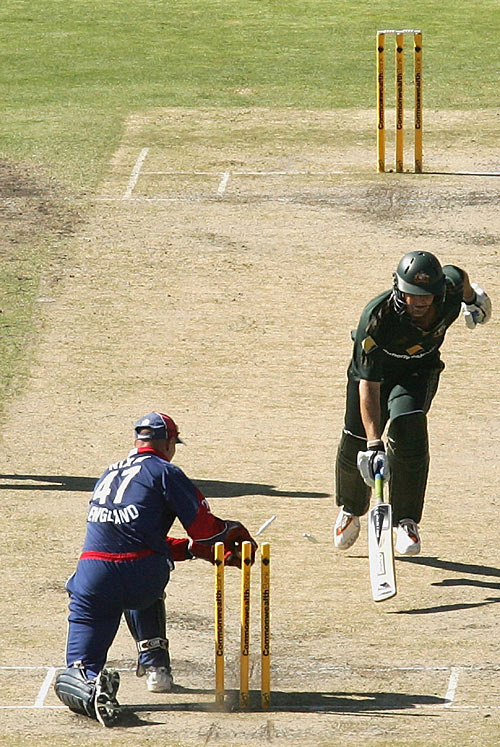 In the previous Australia-England match, Ian Bell and Paul Collingwood were batting, when Bell hit the ball to the left of Cameron White. White dived, knocked the ball down, and went to retreive the ricochet.
What happened next included three of the classic elements of an embarrasing run out. Both batsmen at the one end of the pitch - confusion and panic between batsmen - and both batsmen running towards one end.
It would be stating the obvious to say that this was poor communication between the two players, but something not so obvious showed up in the replays. (Sidenote - for some reason, the more comical the run out, the more tv replays it receives.)
As Bell was changing his mind between 'run' and 'don't run' (i counted about seven changes of mind on the slo-mo replay) there didn't seem to be any glances in the direction of his team-mate - until it was all too late.
Granted, it's important to see what the fielder might do, but in a team game it's about teamwork. It doesn't matter if you think there's an easy run if your partner remains firmly planted at the other end. Team-mates should be on the same page, on the same wavelength, but not at the same end of the pitch.
So it is in life. We are involved in many 'partnerships'. Be it marriage, friendships, a relationship, or at work. Things work best when people communicate, and are clear on what they want to do. As is the case in experienced batting partnerships (eg. Langer and Hayden, Hussey and Clarke) this clarity brings about plenty of success, and very few embarrasing stuff ups.
People who tend to pray often say the same sort of thing. Even if they have nothing 'specific' to pray about, they still have conversations with God. When faced with decisions and wondering "what would God think about this?", it's the experience of talking with God on a regular basis that they say helps in making the tough decisions. (In the same way that it would help Ian Bell if he occasionally looked at his team-mate).
I guess this makes a lot of sense. If God is the ultimate batting partner (to continue the analogy) then it would be quite a smart move to do everything one can to be on the same wavelength.
Saturday, December 23, 2006
On the ball
It's official! Australia has reclaimed cricket's Ashes. And while the final ball will remain in the memory banks for years to come, for me there was another moment that summed up the series.
An attempted sweep by Geraint Jones made no contact. The ball rebounded off his pad and Shane Warne (aided by team-mates) launched into an enthusiastic appeal for LBW. While all this was going on, Ricky Ponting scooped the ball in the direction of the stumps. Jones, seemingly paralysed by the fear that the umpire's decision would extend his series of low scores, had not regained his ground. The result? LBW appeal - not out. Run out appeal - OUT!
It's moments like these that see Australia winning the series quite comprehensively. Whether taking crucial catches rather than dropping them, or reacting to momentary chances, the key to Australia's success is being on-the-ball and taking opportunities. It's not as if England don't know the rules - Australia are just more "keyed in".
Chatting with a friend about Jesus's "Love one another" statements, my friend commented that it's not exactly rocket science. I kind of agreed. With the exception of incredibly selfish individual, most people can grasp the concept of loving one's fellow human beings - after all it's simpler than the rules of cricket ;)
But it's putting it all into action that is the key. Just as in cricket, the challenge is to be alert - see the opportunities - and make a difference.
An attempted sweep by Geraint Jones made no contact. The ball rebounded off his pad and Shane Warne (aided by team-mates) launched into an enthusiastic appeal for LBW. While all this was going on, Ricky Ponting scooped the ball in the direction of the stumps. Jones, seemingly paralysed by the fear that the umpire's decision would extend his series of low scores, had not regained his ground. The result? LBW appeal - not out. Run out appeal - OUT!
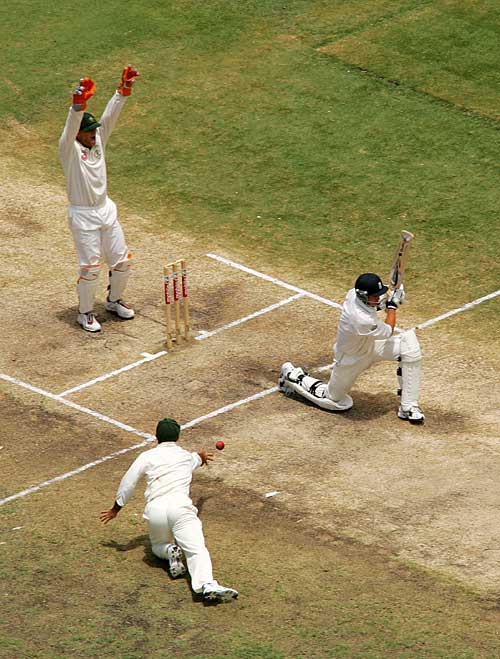
It's moments like these that see Australia winning the series quite comprehensively. Whether taking crucial catches rather than dropping them, or reacting to momentary chances, the key to Australia's success is being on-the-ball and taking opportunities. It's not as if England don't know the rules - Australia are just more "keyed in".
Chatting with a friend about Jesus's "Love one another" statements, my friend commented that it's not exactly rocket science. I kind of agreed. With the exception of incredibly selfish individual, most people can grasp the concept of loving one's fellow human beings - after all it's simpler than the rules of cricket ;)
But it's putting it all into action that is the key. Just as in cricket, the challenge is to be alert - see the opportunities - and make a difference.
Sunday, December 10, 2006
Out the Window
A few of the boys were throwing a few different games around in the changing rooms then, but they all go out the window as far as I'm concerned. That's the best test win I've ever been a part of.
This was the reaction of Australian captain Ricky Ponting after his side's amazing victory in the 2nd Ashes Test against England. I can understand his thinking. At the start of the day, a draw looked by far the most likely option, but somehow, Australia managed to bowl England out with enough spare time to score the required 168 runs to win.
However it must be said that England did not do a great deal to help their own cause. 10 runs from 13 overs in the first hour was incredibly slow, and it didn't get much better. By lunch another 20 runs had been cobbled together, and when the tenth wicket fell, the day's effort was a tedious 70 runs from 54 overs.
There are several theories as to what England were doing. Perhaps they were trying to secure a draw, or perhaps the Australian bowling was just to good. But at the end of the day it seemed that they just had no plan, no purpose and no direction. As a result, they went nowhere.
I think the same is true in life. There is a saying that "If you don't know where you're going, any road will lead there." But if we can work out what our goals are - and ways of getting there - we can achieve so much more.
Of course (just as in cricket) not everything is within our control. Things will change, and sometimes this means changing our plans. But it's better to have to adjust tactics than to not have any to start with.
Friday, November 24, 2006
Ashes - Day 1
It was 14 months ago that the Australian cricket team watched on as England claimed cricket's most prized trophy - for the first time since 1987. Australian players say that day was the first day of the campaign to regain "The Ashes".
62 weeks later, and the first day of the Ashes series went overwhelming in Australia's favour. The excitement was almost tangible as Australia piled on the runs to vigorously take the upper hand at the very start of the series.
Of course, no-one knows what will take place over the remaining four and three-quarter matches of the series. But if the first day is anything to go by - it would seem that the focus, the enthusiasm, the determination and the single-mindedness of the Australian team over the past year and a bit will serve them well during this summer's series.
While the Australian team is an exceptional group of people, I think the same philosophy applies to many people. Having a purpose, and passionately pursuing it, can bring about some extraordinary results - and that doesn't just apply to the cricket field.
62 weeks later, and the first day of the Ashes series went overwhelming in Australia's favour. The excitement was almost tangible as Australia piled on the runs to vigorously take the upper hand at the very start of the series.
Of course, no-one knows what will take place over the remaining four and three-quarter matches of the series. But if the first day is anything to go by - it would seem that the focus, the enthusiasm, the determination and the single-mindedness of the Australian team over the past year and a bit will serve them well during this summer's series.
While the Australian team is an exceptional group of people, I think the same philosophy applies to many people. Having a purpose, and passionately pursuing it, can bring about some extraordinary results - and that doesn't just apply to the cricket field.
Tuesday, August 22, 2006
Holding Out for a Hero
It all started with two words. One started with F and the other with C. Delivered by the Newcastle Knights' Andrew Johns at one of the match officials was enough to see him suspended for two matches.
In the aftermath of that decision, there were the usual discussions about what is and isn't acceptable sporting behaviour. People talked about 'heat of the moment', the competitive nature of professional sport, and the adrenalin rushing through players' veins.
There was a lot of talk about respect for officials. There were rhetorical questions about whether the standards are different for local sport compared to national top-level televised sport. This led to the old favourite "What message does this send to young kids".
The theory is that youngsters admire Andrew Johns for his football ability, and spend their Saturdays (as well as countless afternoons and school lunch hours) trying to emulate his feats. So when the guy swears at a touch judge on national television, people are concerned that young players will also copy that behaviour.
Ideally, these kids would be able to separate the good skills from the poor behaviour; adopting one and steering clear of the other. However, this expecting a lot from young minds.
The problem starts when we idolise people who don't deserve it. Don't get me wrong, Johns is a high-quality rugby league player, and deserves respect for that. But when push comes to shove, he's a guy in his 30's, who's barely had a real job, has already been 'through' one marriage, and is looking at number two. For anyone, child or otherwise, to think "This is the guy I want to model myself on", would be questionable.
In my personal opinion, if anyone's looking for ideas on life from a guy in his early 30's, a better place to look might be the life of Jesus. Sure, if you're looking for advice on kicking synthetic rubber around a sports oval, listen to the words of Andrew Johns. But if you're looking for tips on life, it might be better to look in a little book called the Bible, and hear what Jesus has to say.
In the aftermath of that decision, there were the usual discussions about what is and isn't acceptable sporting behaviour. People talked about 'heat of the moment', the competitive nature of professional sport, and the adrenalin rushing through players' veins.
There was a lot of talk about respect for officials. There were rhetorical questions about whether the standards are different for local sport compared to national top-level televised sport. This led to the old favourite "What message does this send to young kids".
The theory is that youngsters admire Andrew Johns for his football ability, and spend their Saturdays (as well as countless afternoons and school lunch hours) trying to emulate his feats. So when the guy swears at a touch judge on national television, people are concerned that young players will also copy that behaviour.
Ideally, these kids would be able to separate the good skills from the poor behaviour; adopting one and steering clear of the other. However, this expecting a lot from young minds.
The problem starts when we idolise people who don't deserve it. Don't get me wrong, Johns is a high-quality rugby league player, and deserves respect for that. But when push comes to shove, he's a guy in his 30's, who's barely had a real job, has already been 'through' one marriage, and is looking at number two. For anyone, child or otherwise, to think "This is the guy I want to model myself on", would be questionable.
In my personal opinion, if anyone's looking for ideas on life from a guy in his early 30's, a better place to look might be the life of Jesus. Sure, if you're looking for advice on kicking synthetic rubber around a sports oval, listen to the words of Andrew Johns. But if you're looking for tips on life, it might be better to look in a little book called the Bible, and hear what Jesus has to say.
Subscribe to:
Posts (Atom)