Wednesday, April 23, 2008

Baseball

Today i read a piece "life is like baseball". Writer, Howard Butt, describes baseball batting ...

You hold a rounded stick. From 60 feet 6 inches away, a sphere hurls your way at 90 miles per hour. In less than one-half second you must judge the pitch and give it your best swing. If the pitcher adds spin, curve, or drop, it's that much harder. And if you hit the ball? Nine skilled athletes do all they can to stop your progress.

Put like that, it's no wonder that a player is considered a champion if he succeeds one time in three. Often the situation is difficult. Perfection may be out of reach, but we aim for the best possible result.

Saturday, April 12, 2008

Honesty Stroke

This morning I watched televised golf.

That's not something i'd normally say. For that matter it's not something i'd normally do! But there was an ad break in the cartoons, and even tv golf is better than ads.

Anyway, a guy was lining up a putt when, for no apparent reason, the ball moved. He didn't touch it, hit or kick it - it just moved. Now golf being golf, there's a rule that basically says once you've taken up your stance and the ball moves - it counts as a stroke (doh!).

So this guy goes and tells the course official what has happened. He gets a ruling that it is a penalty stroke, and he has to re-place the ball. So he put the ball back to where it was - a whole 3mm away! That's a rotation of about one dimple on a golf ball. It only just showed up on the replay.

So the player would have been the only person in the world who knew what happened. He could have played on. No-one would have looked at the replay. No-one would have known. But this is clearly a guy who knows about honesty, and only wants to win if it's fair and square.

For me that's real character. He may not collect the trophy, but he has integrity. And there's plenty of people who don't have either.

Thursday, April 03, 2008

Super Tyree in SuperBowl

OK, it's a month or two ago, but Superbowl fans would remember David Tyree's amazing catch from Eli Manning's pass to set up the NY Giants 17-14 win in the 2008 Superbowl.


What we didn't know, and what's even more amazing, is Tyree back-story. As covered by the NY Times, Tyree has turned his life around - with God's help. Bigger than any superbowl comeback, "It’s more than just a feel-good story. It’s about destiny and purpose."

"My life was oviously in disarray". He describes his former self "at the pinnacle of sports. But I had no joy. I had no peace." Apparently it all changed when he picked up the Bible.

Wednesday, January 02, 2008

Walking - Ponting

One of the more discussed issues in cricket is "walking". In short, if you are out, but the umpire gives you 'not out', do you leave voluntarily?

Aussie captain Ricky Ponting is one player who appears to be firmly in the 'no' camp. Today, in the first match of the new year, Ponting (on 17) appeared to edge one to the wicketkeeper. Ponting stayed, and the umpire ruled that he didn't hit it.

Then on 55, Ponting inside-edged the ball onto his leg. Ironically, the same umpire again judged that Ponting didn't hit it, and hence gave him out lbw.

And this is the basis of 'non-walker' theory - that when an umpire error goes against you, you have to leave. Therefore (they say) when a decision favours you, you should get to stay.

But the thing that really tips it (for me) is the carry-on of players when they do get given out. There'll be a short stare at the umpire (long enough to make a point - short enough not to be fined for bad sportmanship) a glance towards the bat (in the case of inside edge) all followed up with some grumpy stomping off the field (like a child being sent to their room).

Of course, they'll say that it's all just a natural reaction, and impossible to supress. Yet when they "get away with one", the emotion of guilt seems much easier to hide.

In my view, if batsmen are going to claim "the umpire's the one who decides if i'm out", then it has to be true when it doesn't suit - not just when it does.

Saturday, April 28, 2007

True Supporters

Up until now, i have resisted writing too much about the Cricket World Cup. Partially because of the controversies, and partially because i've just been caught up in Australia's sensational performance. But the other day something caught my eye (or rather my ear) and i just had to comment.

In England's last chance to make the semi-finals, the match with South Africa, they put up a performance which could best be described as woeful. After being bundled out for a mere 154 (from 48 overs, with a tops score of 46 by Strauss) the English bowlers conceded the same amount of runs in less than 20 overs, taking just the one wicket. Clearly this was the end of England's chances in the World Cup, which left their fans disappointed (although you'd think they'd be used to it - after all, they follow England;)

English supporters, being who they are, decided to express their emotions by booing the captain at the on-field post-match presentation/interview. I've never understood the concept of booing one's own team. By definition, that's not the behaviour of a supporter. If you wanna be a supporter - then support. If you wanna boo you're own team - you're not a supporter - you're a critic. Don't call yourself a supporter - you give the rest of us a bad name.

Terminology aside, the underlying issue is that if you decide to be a supporter of a team, it's unconditional. For good, for bad, come what may. Otherwise, you may as well cheer for whichever team is leading on the scoreboard. And that doesn't make sense. Aside from anything else, can you imagine a close match - you might have to switch jumpers up to 20 times ;)

Sunday, January 28, 2007

Yes! Wait! No! ... Sorry!

The mix-up. Batsman hits a shot. One batsman runs, the other doesn't. Both players realise. One player stops, the other goes. Then both stop. Then both go. The stumps are broken ... then just one player goes ... back to the change rooms.

There have been two of these run outs in recent matches. On Australia Day, Gilchrist was looking for a quick single, but his team-mate (Hayden) was not. Gilchrist made it halfway down the pitch (and almost all the way back) before the stumps were broken. It was slightly embarrasing, but not a patch on what had occured 7 days prior.
In the previous Australia-England match, Ian Bell and Paul Collingwood were batting, when Bell hit the ball to the left of Cameron White. White dived, knocked the ball down, and went to retreive the ricochet.

What happened next included three of the classic elements of an embarrasing run out. Both batsmen at the one end of the pitch - confusion and panic between batsmen - and both batsmen running towards one end.

It would be stating the obvious to say that this was poor communication between the two players, but something not so obvious showed up in the replays. (Sidenote - for some reason, the more comical the run out, the more tv replays it receives.)

As Bell was changing his mind between 'run' and 'don't run' (i counted about seven changes of mind on the slo-mo replay) there didn't seem to be any glances in the direction of his team-mate - until it was all too late.

Granted, it's important to see what the fielder might do, but in a team game it's about teamwork. It doesn't matter if you think there's an easy run if your partner remains firmly planted at the other end. Team-mates should be on the same page, on the same wavelength, but not at the same end of the pitch.

So it is in life. We are involved in many 'partnerships'. Be it marriage, friendships, a relationship, or at work. Things work best when people communicate, and are clear on what they want to do. As is the case in experienced batting partnerships (eg. Langer and Hayden, Hussey and Clarke) this clarity brings about plenty of success, and very few embarrasing stuff ups.

People who tend to pray often say the same sort of thing. Even if they have nothing 'specific' to pray about, they still have conversations with God. When faced with decisions and wondering "what would God think about this?", it's the experience of talking with God on a regular basis that they say helps in making the tough decisions. (In the same way that it would help Ian Bell if he occasionally looked at his team-mate).

I guess this makes a lot of sense. If God is the ultimate batting partner (to continue the analogy) then it would be quite a smart move to do everything one can to be on the same wavelength.

Saturday, December 23, 2006

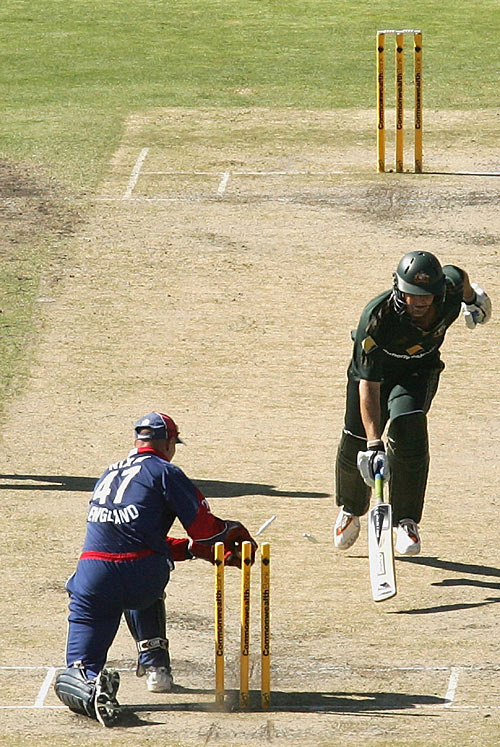
On the ball

It's official! Australia has reclaimed cricket's Ashes. And while the final ball will remain in the memory banks for years to come, for me there was another moment that summed up the series.

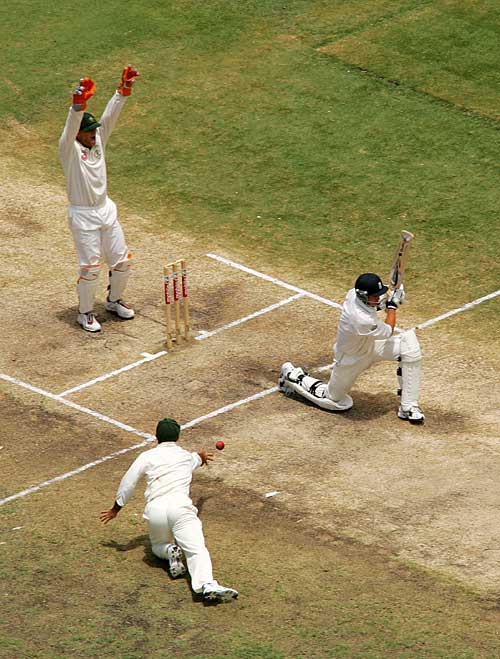
An attempted sweep by Geraint Jones made no contact. The ball rebounded off his pad and Shane Warne (aided by team-mates) launched into an enthusiastic appeal for LBW. While all this was going on, Ricky Ponting scooped the ball in the direction of the stumps. Jones, seemingly paralysed by the fear that the umpire's decision would extend his series of low scores, had not regained his ground. The result? LBW appeal - not out. Run out appeal - OUT!


It's moments like these that see Australia winning the series quite comprehensively. Whether taking crucial catches rather than dropping them, or reacting to momentary chances, the key to Australia's success is being on-the-ball and taking opportunities. It's not as if England don't know the rules - Australia are just more "keyed in".

Chatting with a friend about Jesus's "Love one another" statements, my friend commented that it's not exactly rocket science. I kind of agreed. With the exception of incredibly selfish individual, most people can grasp the concept of loving one's fellow human beings - after all it's simpler than the rules of cricket ;)

But it's putting it all into action that is the key. Just as in cricket, the challenge is to be alert - see the opportunities - and make a difference.